Constellation Antlia (Air Pump)
Properties
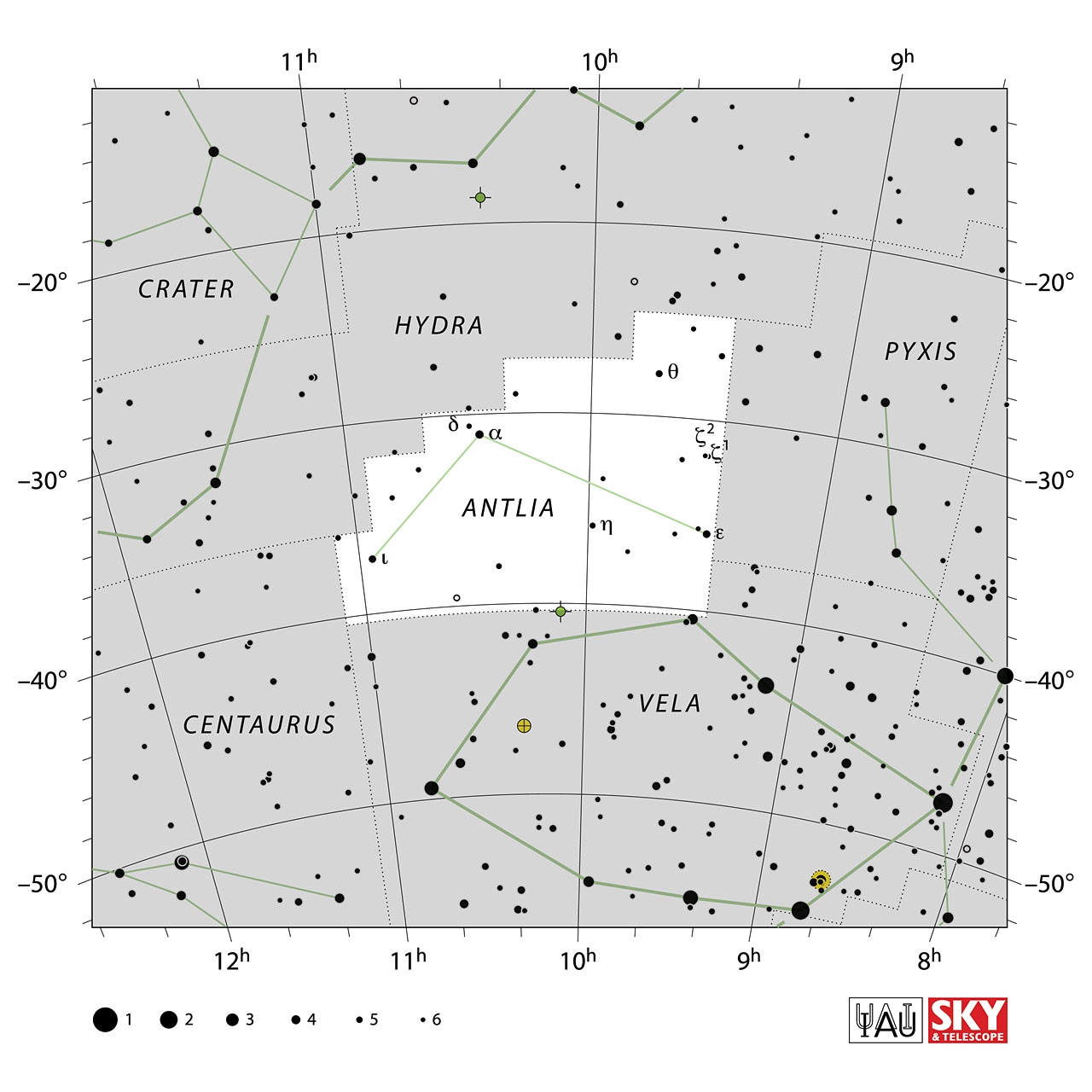
Like many of the «modern» constellations, Antlia is an inconspicuous gap filler between the large and bright constellations east of the Milky Way ribbon. The star alignment in no way resembles an air pump. The constellation covers an area of 239 square degrees, but it does not contain stars brighter than 4th magnitude and also no real Milky Way objects (nebulae, clusters), just a scattering of faint galaxies and a handful of double stars. Antlia lies between Hydra and Vela and culminates at midnight on around 18 February. For Central Europe it just comes up over the southern horizon in winter. [7, 9, 12, 15]
| IAU Name | Antlia |
| IAU Genitive | Antliae |
| IAU Abbr. | Ant |
| English Name | Air Pump |
| Culmination at local midnight | 18 February |
| Season (Latitude +0.0°) | October … July |
| Right Ascension (J2000.0) | 09h 26m 56s … 11h 05m 55s |
| Declination (J2000.0) | -40° 25' 29" … -24° 32' 33" |
| Area | 239 deg2 |
Catalogues
History
The French astronomer Abbé Nicolas Louis de Lacaille introduced the constellation Antlia Pneumatica around 1752. It was intended to commemorate the invention of the air pump by the English physicist Robert Boyle. Lacaille, who was the first to completely map the southern sky from an observatory on the Cape of Good Hope, created several new constellations to fill the gaps between existing figures. However, most of these constellations are just as inconspicuous as Antlia. The name was shortened to Antlia in 1930 by the International Astronomical Union (IAU). [7, 10, 12, 15]